Mar 132020
John Pike

Feb 022020
THE 2020 AGM due to be held on Wednesday 18th March 2020 HAS BEEN POSTPONED because of the risks associated with the Corona Virus
The date of the postponed meeting will be notified in due course
Mar 132019
Recent Additions to our Collections
The Society is pleased to have received a number of items to add to its collections, including the following:
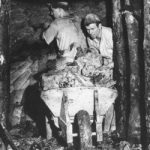 A reconstruction of the type of Wheelbarrow used in underground shafts in South Devon until the early 1950’s. This was made by Simon Cunningham, a former Teignbridge ranger who was responsible for the visitor centre at Decoy Country Park, the site of the former Devon & Courtenay clay works, and it was part of a small exhibition relating to the old clay workings. Simon’s only guide as to the construction of the wheelbarrow was the attached photo showing Geoff Gibbs and Les Bickham in Bill Tribble’s shaft in Southacre, Preston Manor, Kingsteignton in 1951. The wheelbarrow has been donated to the Society by Teignbridge District Council.

- Sixteen boxes of title deeds of the Devon properties of Watts, Blake, Bearne & Co. presented to the Society by Sibelco UK, being superfluous to the company’s needs following the registration of the titles. The deeds are of considerable local historical interest, relating as they do to the many properties in Kingsteignton and Newton Abbot that were acquired by WBB & Co. subsequent to the establishment of the partnership in 1861. Two boxes contain deeds of the earliest clay partnerships of the late 18th and early 19th centuries. It appears that they have not been accessed for a considerable time, and may well cast new light on the early history of ball clay working in the Bovey Basin.
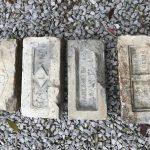 Four different Bricks produced by the North Devon Clay and Brick Works in the late 19th century, each stamped with a different company stamp; presented by Michael Messenger, the author of ‘North Devon Clay’.
- An original Painting entitled “The Bonawe loading China Clay at Poole”. The painting depicts the coaster ‘Bonawe’ alongside Poole Quay (with Poole Pottery chimneys in the background) and a barge alongside it from which clay is b

The ‘Bonawe’ loading ball clay from a barge alongside, Poole Quay, c.1920’s
eing loaded in baskets onto the vessel. The ‘clay’ must actually have been ball clay that had been transported in the barge across Poole Harbour from the Wareham basin ball clay works. The painting shows white dust emerging from the hold suggesting that the clay must have been very dry and powdery! The same method of transferring clay from barge to sea-going vessel was employed at Teignmouth, often with the vessel moored in the harbour. The ‘Bonawe’ was owned and operated by J & A Gardner & Co. Ltd. of Glasgow, shipowners and operators of the Bonawe stone quarry on Loch Etive. The painting, which is very fine, was probably made in the 1920’s and is a rare example of a work of art depicting the production or transport of ball clay. The artist, Maurice Clarke, may have been an art teacher at Repton and Harrow schools.
Mar 092017
BALL CLAY HERITAGE SOCIETY
Eighteenth Annual General Meeting: 9 March 2017
CHAIRMAN’S ANNUAL REPORT
Welcome to the 18th AGM of the Ball Clay Heritage Society.
I am sorry to report that we have suffered some sad losses in recent months. As I expect you are all aware, Tony Vincent passed away unexpectedly last October. After joining the Committee in 2005 Tony made a huge contribution to the Society, cheerfully taking on the tasks of developing our much admired website, cataloguing our photograph collection and editing our newsletter. His passing has revealed how much we owe to him. Another sad event recently has been the passing of Pat Proctor who with husband Reg has been a strong and active supporter of the Society for many years. And just last Friday Fred Cox passed away. He was a keen Society member who worked for WBB and, amongst other attributes, was a very talented artist and constructor of the Abbrook bowling green. I would like to ask you all to stand for a moment in memory of Tony, Pat and Fred.
I would like to update you with what the Society has been doing over the last twelve months.
The General Committee met in June, October and January. We are very pleased that Darrin Hewings , who is Sibelco’s South Devon quarries manager, joined the Committee at the last AGM. Individual committee members have, as always, been involved with quite a lot of activity, and I would like to take this opportunity to thank the committee members for their efforts on behalf of the Society during the year.
With regard to events, at our AGM in March 2016 Darrin stepped in to give us a very enjoyable talk on “Ball Clay Through the Ages”.
In October the Society had a really well organised visit to the Wolf Minerals tungsten operations at Drakeland hosted by former WBB employee, Tony Hearn, who is now a manager of the engineering company that installed the process plant. This is a huge project involving the investment of about £125 million and involves a very extensive process to extract just 0.17% of tungsten and 0.02% of tin from the millions of tonnes excavated each year. It was amazing to realise that this operation is a stone’s throw from Sibelco’s Headon china clay pit. As mentioned in the Notice of the meeting it may be possible to arrange another visit to Drakelands. If you are interested please let Geoff or Bryn know.
We are planning to organise a visit during this summer to Sibelco’s South Devon operations and a guided visit to see the restoration work on the Ventiford Basin and Graving Dock Lock on the Stover Canal in September, and other activities. As also mentioned in the Notice there will be a skittles evening with Stover Canal Trust members on 7th April. Those interested should contact Pauline Harrap.
During the year we continued to receive some additions to our collections. In May we were presented by Rob Harris with an ex-WBB battery charger unit for underground miners’ lamps. Beryl Vincent kindly donated Tony’s collection of books, maps, papers and other materials relating to the clay industry.
Until the day before he passed away Tony was continuing to make substantial progress in scanning and cataloguing our collection of prints and slide photographs. We are now looking for one or more volunteers who will take up this task using the Modes cataloguing software, ideally – but not necessarily – people who are familiar with the scenes in the photographs.
Similarly we are looking for someone to take on the management of our clayheritage.org website which is an important link for the Society with the outside world, containing as it does a great deal of information about the ball clay industry and generating enquiries relating to the history of the ball clay industry. Chris Meathrell has volunteered to edit the next version of the Society’s Newsletter
We had an interesting visit in July from Alan Denley, an old Newtonian whose interest in railways led him to old photos showing the Devon and Courtenay clay cellars near the old power station by the Town Quay.
The Society has taken on a project to research the impact of the First World War on the South Devon Ball Clay industry and the consequent impact on the communities of Kingsteignton and Newton Abbot. This is under the auspices of the Devon county-wide Heritage Lottery funded “Devon Remembers” project. Valuable research into local newspaper reports and military tribunals is being carried out by Richard Harris and John Ellis and I am researching our archive material relating to the First World War period with support from Geoff Hughes. The main stories concern the calling up of clay workers and the difficulties of supplying customers, especially because of the sinking by German submarines of many cargo vessels – several carrying clay from Teignmouth. We have been asked to contribute our research notes and exhibition texts and copy documents by sometime in 2018.
I mentioned last year that the Neighbourhood Development Plan for Newton Abbot advocated the provision of new premises for the Town Museum in the town centre. Things have now moved on and the Town Council has purchased the former St Leonard’s Church in Wolborough Street to house both the Museum and the Town Council under the title “Newton’s Place”. Discussions have been held with the Museum’s curator and we are hopeful that there will be space for a small permanent display about the ball clay industry. Whether there will be space to house at least part of the Society’s collections of archive materials and photographs remains to be seen.
The Teignmouth and Shaldon Museum continues to display several of the Society’s small artefacts in its ball clay industry display, and Newton Abbot Museum continues to display the Society’s Bronze Age spear head and some other objects.
As mentioned at last year’s AGM, Sibelco offered to house the Society’s mining equipment that was previously kept at the old carpenters’ workshop at Abbrook, in the old tyre workshop at Preston Manor. Darrin Hewings has since arranged for all the equipment to be moved to its new home. The most important piece of equipment is the Fuchs mining machine that was dis-assembled in the early days of the Society. This is now being re-assembled in the old fitters’ workshop at Preston Manor where there is suitable lifting gear – the Society’s mobile lifting device having disappeared from Abbrook. The work is being carried out by some of the current employees who are familiar with the machine when it was operating underground until 1999.
Darrin is arranging for one of the Society’s four steel underground mining wagons to be painted and installed at the roundabout at the Kingsteignton end of Clay Pits Way, as a symbol of the clay industry’s heritage.
I should mention that we have concerns about what has happened to Jimmy Samways whom many of us know from Society trips to Dorset. We understand that he has moved out of his home near Wareham where he had a substantial collection of artefacts from the Dorset ball clay industry. We think these would probably be best preserved by the Purbeck Mineral and Mining Trust.
The Society was represented with a stand at Volunteer Fairs organised by Teignbridge District Council at Forde House and Market Walk, and the Society has become a member of the Teignbridge Heritage Forum that emerged from the same initiative.
We welcome your comments and suggestions regarding what the Society does or should do. We would especially like your views on future talks and outings. Anyone interested in researching or just browsing through our collections of archive material and photographs will always be very welcome at Dunderdale Lawn.
John Pike
Chairman
7 March 2017
Oct 222016
THE BALL CLAY HERITAGE SOCIETY
Visit report to Wolf Minerals’ Drakelands Tungsten Mine,
22 October 2016.
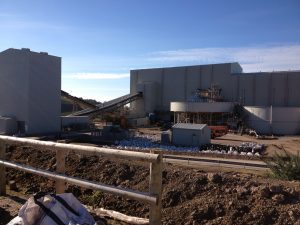
The Drakelands processing plant
Twelve members of the Society travelled to West Devon at the invitation of Wolf Minerals for a guided tour of this new operation 12 Km east of Plymouth producing both speciality tungsten and tin concentrate. The facility employs approximately 200 operatives, many from nearby locations and is potentially one of the Western world’s largest resources of tungsten and tin ore.
Tungsten is used in a range of industrial applications including cemented carbides, steel alloys, metal cutting tools including drill bits, lighting applications and jewellery. Tungsten metal is extremely hard and has a melting point in excess of 3,000°C.
The ore body at Drakelands mine lies within and around a body of porphrytic granite known as the Hemerdon granite which is situated to the southwest of the main Dartmoor granite mass. This ore body is approximately 140m wide and drilling indicates an overall depth of some 400m below ground level with wolframite (tungsten ore) and cassiterite (silver) ore being the two sought-after minerals. Reserves are estimated at 59 million tonnes with W03 grade (tungsten) of 0.17% and Sn grade (tin) of 0.02%.
Open pit mining is used from a area measuring 800m x 400m with a terminal depth estimated at 250m. Currently, the uppermost layer of material is being removed by dump trucks and this contains quantities of waste material which dilutes the amount of recoverable wolframite and cassiterite but as this material is removed, the main ore body will be exposed which contains the higher proportion of these two valuable products.
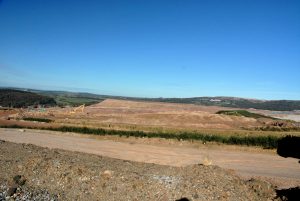
The massive settling dam
A massive settling dam has been constructed using lined waste rock and is being used to store “slimes” with the liberated water being returned to the processing plant for re-use. This dam will be further extended as more waste is deposited and forms part of returning worked out areas to nature which has already resulted in the planting of thousands of young trees, building of “bat hotels” and restoration of heath land.
The processing plant produces tungsten and tin concentrates from the crushed and ground feedstock in a wet process using gravity, heavy media separation and magnetic separators and when working to capacity will produce approximately 5,000 tonnes of tungsten concentrate and 1,000 tones of silver concentrate per annum for export to Europe, the U.S.A. and Asia.
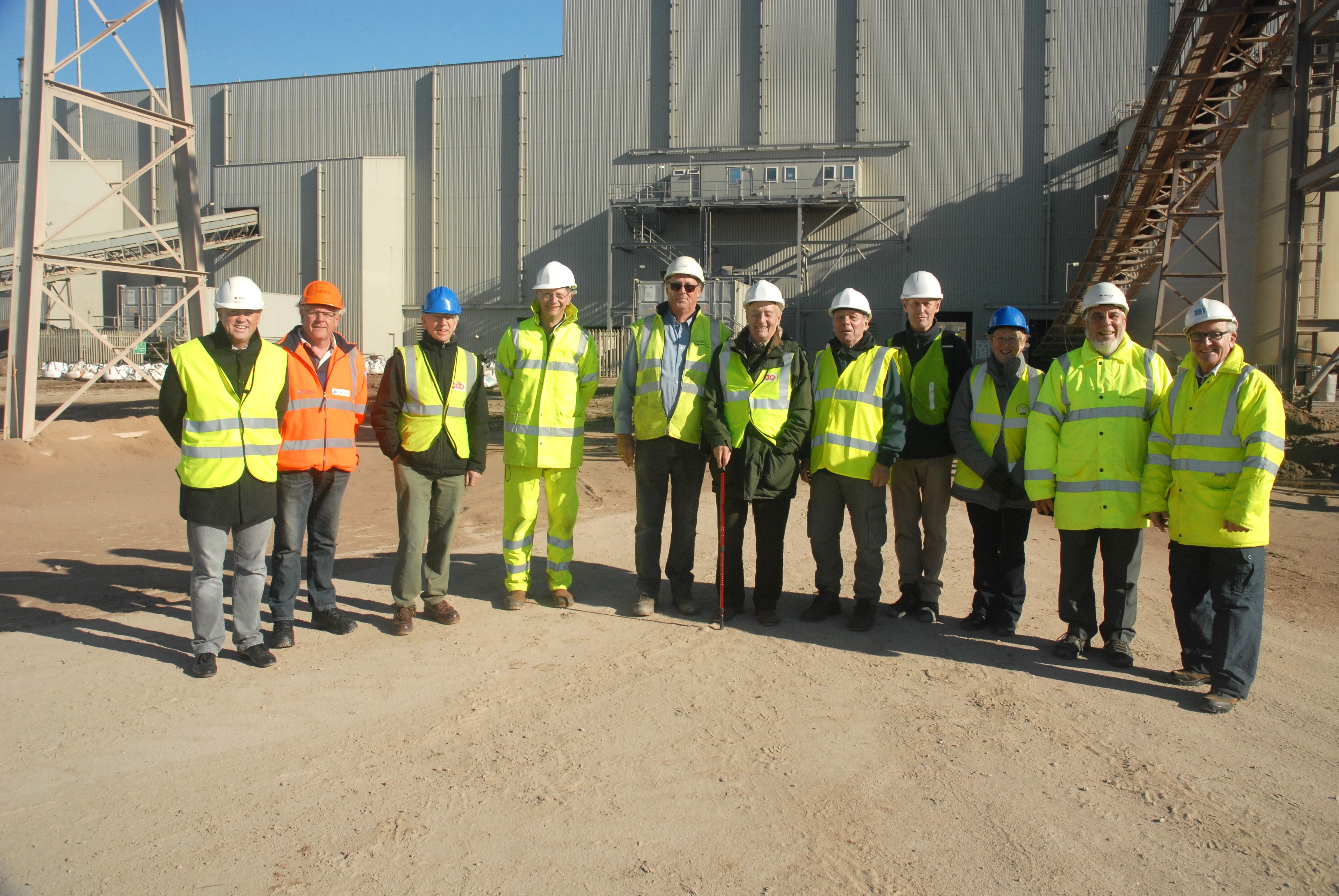
Society Members and Tony Hearn
The visit concluded with and audio/video presentation and question and answering session conducted by our guide Tony Hum and a vote of thanks by John Pike.
Report by Geoff Hughes