 The Ball Clay Heritage Society now has a Facebook Page – take a look and share photos from our archive, up-to-date news, join in conversations – and much more at www.facebook.com/BCHS.2000.
s
s

The Ball Clay Heritage Society now has a Facebook Page – take a look and share photos from our archive, up-to-date news, join in conversations – and much more at www.facebook.com/BCHS.2000.
s
s
Welcome to the 20th AGM of the Ball Clay Heritage Society.
As usual I would like to update you with what the Society has been doing over the last twelve months.
The General Committee met in July and November. There has been no change in the members of the Committee. However we have been saddened by the death in December of George Copp who had been manager of the North Devon Clay Company. He was a highly respected member of the local community and an invaluable source of information on the history of ball clay industry in North Devon.
At our last AGM the Revd. Nicholas Pearkes gave a splendid talk on the Lost Mine of Penn Recca and the Lost Canal of Littlehempston, which was a lesson in how a once thriving mining concern could vanish almost without trace. In May Richard Harris gave us a very interesting talk on the Hackney Canal and Quay. Unfortunately there are not too many traces left of those facilities either. We had hoped to organise another visit in the autumn to Wolf Minerals tungsten mine and processing facility but the company has gone into administration and it too seems to be going the same way as the Lost Mine of Penn Recca.
Luckily the ball clay industry is far from disappearing! In July a group of members were given a tour of Sibelco’s Preston Manor a
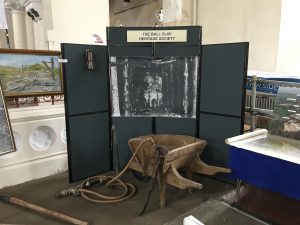
The Wheelbarrow exhibited at St Leonard’s Church (future Newton’s Place), Newton Abbot in June 2017
nd East Golds works and were very impressed by the dramatic expansion of the pits at Preston Manor following the closure of the Chudleigh Road. Last year Darrin Hewings organised one of our steel underground mining wagons to be placed by Sibelco on the ‘Clay Pits’ roundabout, and he has now added our underground mining machine which he arranged for volunteers to re-assemble. I think the installations have made quite an impact.
An earlier piece of equipment used underground was the humble wheelbarrow and we have been given by Teignbridge District Council the wheelbarrow that Simon Cunningham, a former TDC ranger, reconstructed from the iconic image of Geoff Gibbs and Les Bickham working in Bill Tribble’s shaft in the early 1950’s. In recent exhibitions we have used the wheelbarrow, a pneumatic spader and other artefacts in conjunction with a large reproduction of the iconic image to give a strong impression of conditions that used to exist underground.
We would like to reconstruct the ‘crab’ mining headgear that used to be at the Abbrook social club and is characteristic of South Devon ball clay, but we are currently lacking details of its original dimensions.
The Society’s archive collection has been considerably enhanced during the past year by the important donation by Sibelco of 16 boxes of Watts Blake Bearne title deeds which the company no longer requires because all its titles have now been registered. The deeds relate to dozens of parcels of land in Kingsteignton and Newton Abbot and are of considerable local historical interest. I am familiar with most of them as one of my first jobs when I joined the company in the 1970’s was to go through them all and fit together the ‘jigsaw’ of the company’s landholdings. Particularly valuable are a couple of boxes of very old deeds going back to the end of the 18th and early 19th centuries, which I believe no one has seen in recent times. Some relate to the earliest clay merchants and the partnership formed by Agnes Watts, William Mortimer, Samuel Whiteway and John Hatherly, that was based partly on land at Abbrook acquired in the 1820’s from the financially stretched George Templer.
Other acquisitions during the past year were four bricks produced by the Marland Brick and Clay Works in the 19th century, presented to the Society by Michael Messenger, and a very fine painting of a vessel called the ‘Bonawe’ loading ball clay at Poole quay from a barge moored alongside – the same system that was used for transferring clay from barges to vessels in Teignmouth Harbour. The painting was made in the 1920’s and as far as I know it is the only known work of art depicting the transport of ball clay.
Conversion of the former St Leonard’s church in Newton Abbot to ‘Newton’s Place’ is well in hand. Discussions have been held with Felicity Cole, the museum curator, on what items from the Society’s collections could be included in a ball clay exhibit there on a more or less permanent basis, and she is considering this with the designers. She is offering the Society the opportunity to mount a temporary exhibition in August 2020 in rooms that at other times of the year will be used by the Town Council. Unfortunately there will be insufficient space in Newton’s Place for the Society’s archive collection that is currently in the cellar of my house. However on a visit by Bryn and me to Devon Heritage Centre in November it was confirmed that the Centre was willing to accommodate the collection, although I suspect that they may be selective in what they take. Photographs could also be accommodated but the Society’s artefacts would have to go to Newton’s Place.
The Devon Remembers project was completed last year with the publication of the book “Devon During the First World War” containing 22 chapters summarising the individual research projects, including one on the ball clay industry put together by John Ellis, Richard Harris and myself. The leader of the Devon Remembers project, Katherine Findlay, published her book on “The Icelandic Adventures of Pike Ward” based on the diaries of the 19th century founder of the Teignmouth shipbroker of the same name. During his long visits to Iceland his redoubtable mother Elisa ran the shipbroking business. Katherine found in our letter books much friendly correspondence between Elisa and Charles Blake of Watts Blake Bearne, and I understand that Lou Bagnold, the chair of Teignmouth and Shaldon museum, intends to make use of it in a book that she is planning to write about Elisa Ward – who, incidentally, was a Pike from Chudleigh and was probably related to the Pike from Chudleigh who founded Pike Brothers, the Dorset ball clay producer.
Steve Carreck is making slow but steady progress with the conversion of our www.clayheritage.org website to WordPress. The website continues to generate interest and enquiries – such as from the American asking who he should contact in the USA to obtain ball clay for making clay tobacco pipes. We would like a volunteer to take on the job of managing the website and we have not yet manged to restart the publication of our newsletter or the formal cataloguing of our photographs following the sad loss of Tony Vincent. However Darrin has organised regular sessions with retired clay workers to go through our photographic collection and identify people and places appearing in them. Darrin and Bryn have given a number of talks to local groups on the history of the ball clay industry.
We welcome your comments and suggestions regarding what the Society does or should do. We would especially like your views on future talks and outings. Anyone interested in researching or just browsing through our collections of archive material and photographs will always be very welcome at Dunderdale Lawn.
– John Pike
Chairman
12 March 2019
At the 2019 AGM, Stuart Drabble, former bursar of Stover School, gave a very interesting talk based on his important new book “Haytor Granite” that was published in January.
The book describes the businesses set up by George Templer of Stover and his successors to produce the granite, its transportation via the Haytor Granite Railroad, Stover Canal and Teignmouth Quay for its use in London Bridge and many famous buildings and monuments. The book is very thoroughly researched and contains many photographs illustrating the very readable text.
Find out more about the book in The Dartmoor Magazine.
Welcome to the 19th AGM of the Ball Clay Heritage Society.
As usual I would like to update you with what the Society has been doing over the last twelve months.
The General Committee met in July, October and February. The only change in the membership of the committee was the resignation of Cllr Chris Meathrel, who had been nominated as a committee member by Kingsteignton Town Council, and his replacement by Cllr Bill Thorne, whom we are very pleased to welcome to the Committee.
At our last AGM we had a very interesting talk by Helen Turnbull on “The Cliffords of Ugbrooke Park”, reminding us that various generations of the family were rather distinguished and important for reasons other than their clay leases and the collection of dues paid by the ball clay merchants for their use of the Hackney Canal.
In June last year we mounted an exhibition in Newton’s Place – the former St Leonard’s Church – for an open day when members of the public could view the building and see the preliminary plans for its conversion into the Town museum and community centre. The Newton’s Place project is progressing and we are hopeful that there will be space in the final layout for a permanent display relating to the ball clay industry. We have been approached by Devon Archives in Exeter as to the future storage of our archive material and collection of photographs, but our preference is for these to be kept in Newton Abbot if possible. There is a debate about whether the organ should be retained in Newton’s Place, but this would significantly reduce the space for the storage of archive material and historic objects that could not otherwise be kept.
In September we had a display at the Stover Canal Trust open weekend. We made use of the ‘pop-up museum’ that was created as part of a project by Johanna Korndorfer and Mandy Biscoe a few years ago. It doesn’t exactly ‘pop-up’ and in fact it’s rather heavy but it has some good features. We have now taken possession of it.
As I am sure most of you have seen, Darrin Hewings has arranged for one of our steel underground mining wagons to be placed on the roundabout at the beginning of Clay Pits Way, displaying mystery numbers that change from time to time! He has also organised the re-assembly of the Fuchs underground mining machine which he is going to place on the roundabout as if it is feeding clay into the wagon. I am not sure how far Devon Highways tolerance stretches, but ultimately it is hoped to place some steel arches over the wagon and mining machine so that motorists can enjoy an open air mining museum as they drive around the roundabout.
I am pleased to say that the ‘Devon Remembers’ project on the local ball clay industry in the First World War was completed in December. This involved a lot of research by Richard Harris, John Ellis and myself into local newspapers, military tribunal reports and thousands of pages of correspondence contained in the Watts Blake Bearne letter books of the period. The product of our work is a timeline in chronological order of 65 pages of extracts from those documents and a chapter for the book that is to be produced as the final stage of the Devon-wide project. Apart from the main stories such as the calling up of clay workers and the consequences of the sinking by German submarines of many cargo vessels, it was fascinating to read the correspondence between CD Blake –- who was then aged about 80, the much respected senior partner with 55 years’ knowledge of the business, but completely blind and dictating a stream of letters by phone to Park House from his house Highgrove, a young Mr William Watts who went off to serve in Palestine and Arthur Bearne who with a handful of office staff was keeping the business going but regularly pressing Mr Blake to agree to pay another dividend.
We have provided our Devon Remembers project material to some local schools and hope thereby to generate more interest in the history of the ball clay industry. Darrin is also doing an excellent job giving talks on the history of the industry to local groups.
At the end of February Jane Chilvers of Sibelco opened up her secret store at Preston Manor of documents that she rescued from Park House when the office was closed in 2001, and I have selected a number of files and ledgers, including some very interesting records of plant and other assets, which I have added to our archive collection.
We are still very much missing the enormous contribution that Tony Vincent made to the Society. However I think we are getting closer to the point at which we will have volunteers who can resume the task of cataloguing out collection pf photographs. We are also looking for a new editor of our newsletter, Chris Meathrel having resigned.
Steve Carreck is making progress with the conversion of our www.clayheritage.org website to WordPress, which should make the content easier to manage, and has produced a number of revised pages for Committee members to review. We will need a volunteer to take on the job of managing the website and possibly also contributing photographs to the WBB Minerals Facebook pages.
Having almost exhausted our stock of our booklet “The Ball Clays of Devon and Dorset”, we have been able to purchase from Tor Mark another 150 copies, leaving only about 50 copies with Tor Mark.
Our social programme was confined to a very enjoyable skittles evening with Stover Canal Trust members in April, as unfortunately we were unable to follow up our very successful visit to Wolf Minerals tungsten mine at Drakelands in October 2016 with another Society visit. However Wolf Minerals have now themselves resumed public visits for individuals to join. We now have a talk by Richard Harris on the Hackney Canal and Quay arranged for 8thMay, and a visit to Sibelco’s South Devon ball clay works on 3rd July. We are also hoping to arrange a guided walk of the Stover canal with John Ellis to see the restoration work at Graving Dock Lock and Ventiford Basin.
The Teignmouth and Shaldon Museum continues to display several of the Society’s small artefacts in its ball clay industry display, and Newton Abbot Museum continues to display the Society’s Bronze Age spear head and some other objects.
We welcome your comments and suggestions regarding what the Society does or should do. We would especially like your views on future talks and outings. Anyone interested in researching or just browsing through our collections of archive material and photographs will always be very welcome at Dunderdale Lawn.
John Pike
Chairman
13 March 2018
The Society continues to play an important role in preserving the heritage of the ball clay industry. Since our last Newsletter numerous talks have been given, displays mounted at various events and our website has been a valued source of information. A highlight of the past year has been the completion of the ‘pop-up museum’ and its use at Bovey Tracey Craft Festival and the Stover Canal Open Weekend – see more about this below. Members have had several very interesting visits to Imerys’ ball clay operations in South Devon and Dorset, and have taken part in the activities described below. They have also enjoyed talks by Richard Harris on Hexter Humpherson and Sandygate Pottery, by Frederick Nicholls on Puzzle Jugs of Devon, by Ken Edworthy on the Geology of Kingsteignton and by Darrin Hewings on the South Devon Ball Clay Industry.
We have received several additions to our archive and photographic collections, and our collection of mining equipment that has been stored at the former carpenters’ workshop at Abbrook, but is shortly to be moved to more secure premises at Preston Manor, thanks to the strong support that we receive from Sibelco. We remain optimistic with the backing of the Teignbridge Local Plan and Newton Abbot Neighbourhood Development Plan, the Newton Abbot Museum will move to larger premises in the town centre, giving the opportunity for more permanent displays on the ball clay industry. Meanwhile, the restoration work on the Stover Canal is drawing attention to the long history of the industry for which it was created.
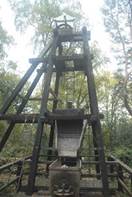
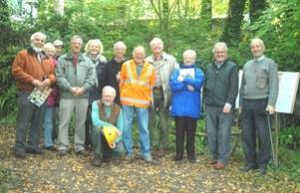
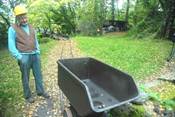
Our Society enjoyed another visit to this unique site near to Lustleigh. We were rewarded by a series of astounding restorations that had been accomplished since our last visit. In its heyday, Kelly Mine produced an uncommon form of micaceous haematite, which among other things was used in the manufacture of industrial paints to give weather resistance, “black lead” polish and in ceramics. Sadly the mine was closed down in 1951, but in the intervening years, the Kelly Mine Preservation Society (KPMS), has done much to re-furbish structures that would have been lost forever.
 |
 |
 |
 |
 |
 |
 |
|
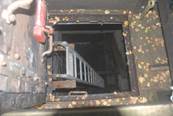
The bottom Adit has been re-opened and excavation continues under strict safety requirements. Much of the ore processing equipment has been salvaged and returned to working order, using the original water power. Most impressively, the vertical shaft has been tidied up and made safe and the head gear has been totally re-constructed using reclaimed timber. Our thanks to the members of the KPMS for an outstanding morning out and for their excellent commentaries. (Geoff Hughes)
The Met Office was founded in 1854 and re-located to Exeter in September 2003. It is an executive agency of the Ministry of Defence. Our party was split into two for the visit, which lasted around 3 hours. We were shown the display of instruments used at the inception of forecasting, when the Met Office first came into being. The sophisticated systems in use today include the super computer suite, which is capable of performing 16 billion calculations per second! Our visit included an impressive library as well as a display of old paintings and photographs. All in all, we were very impressed by the whole visit and our thanks go to our excellent guides for their patience and explanations. (Geoff Hughes)
John Pike, Geoff Hughes and Tony Vincent visited Sibelco with Martin Milne and Clover (she is a Geography Graduate and younger than Martin who is 50 years old now). They gave us a talk at the Office (East Golds) before visiting Preston Manor. They are now using 3D SurPak rather than AutoCad. They explained what was being planned. With the B3193 now diverted, there is onward northern development of White Pit for Groups 2, 3 and 4. It will be through the road that is going to be removed in April 2016, from the north of the Southacre Sheds. Removal of parts of Binney Tip was the onward development of Southacre Quarry, which Tony advised Martin of in 1998, after the river diversion was not available. The northern end of Southacre Quarry is now worked out. We then visited Southacre Quarry, White Pit, John Acres Lane Quarry and Denistone Quarry, which Tony took photographs of, printed and included in the appropriate categories (Modes and the Prints Cabinet).
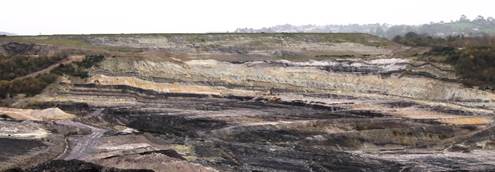
(Above) Southacre Quarry looking south. Some of the right hand side of Binney Tip was removed to enable the extraction of the Goosehams Member (Group 2 clays). Underneath that is mainly sand and the Parks and lower is the Group 1 clays interspersed with lignitic bands. The base of the quarry is mainly lignitic material, which is about 20 metres thick, before the main Group 2 clays appear.
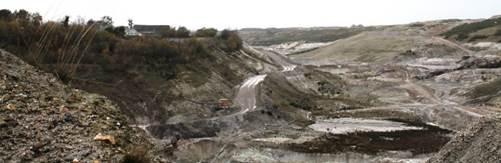
(Above) South of John Acres Lane Quarry (SJAL) in the last decade or so was joined to White Pit through John Acres Lane. Preston Manor Works is above to the left. SJAL Quarry and the southern end of White Pit are now worked out and will be backfilled with the overburden that will be removed in the immediate future. (Tony Vincent)
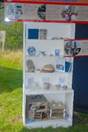 Stover Canal Open Weekend – 19th/20th September, 2015:
We exhibited at this open weekend, when we received a steady stream of visitors who were no doubt attracted by the new “Pop-up” Museum, which resulted in a number of compliments, as well as a steady stream of questions.
 The “Pop-up” Museum was designed by Mandy Biscoe & Johanna Korndorfer and was paid for by the Heritage Lottery Fund with contributions from the BCHS, Sibelco and Imerys.
The pictures of the “Pop-up” Museum are shown to the right. An additional bonus was that some new members were signed up. For a pleasant change, the weather was kind to us!
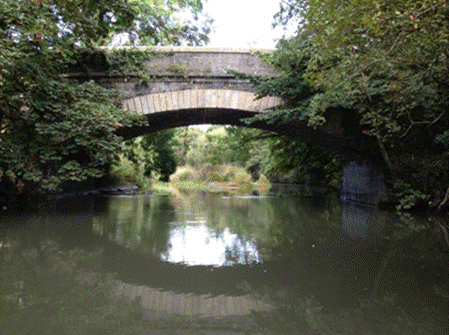
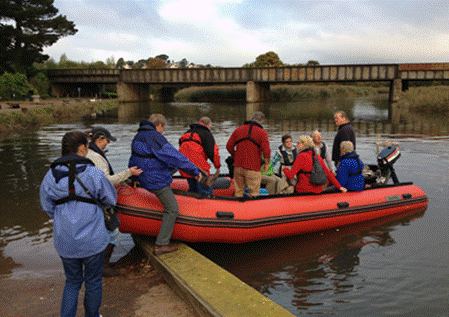 Twelve of us donned life jackets when the tide was high and boarded an inflatable at Newton Abbot Town Quay near the head of the Teign estuary. For the next hour and a half Jez Pilkington of ‘Pilkington’s Pirates’ gave us a splendid guided tour of the waterways around Newton Abbot. First we went up the Whitelake Channel under the very low Kingsteignton Bridge (ducking essential!) as far as the Jetty Marsh Basin of the Stover Canal – the quays looking impressive but in need of restoration.
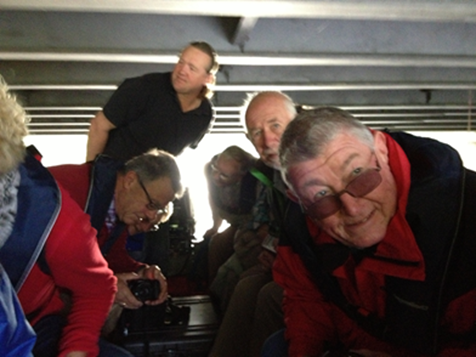 We then cruised up the River Teign past the racecourse – a rather beautiful section – and into a ’jungle’ of overhanging trees that makes the river almost (but not quite) impassable up to Teign Bridge. We next travelled up the River Lemon –somewhat claustrophobic between the high walls and buildings – as far as the Avenue Bridge, which at the then state of the tide was too low for us to pass under – so no stop-off at ASDA.
We returned to the estuary – which looked very serene – and after making a short detour up the Aller Brook, crossed to see Hackney Quay and the sea lock of the Hackney Canal. A really fascinating trip that reminded one of the importance of these waterways to the commercial history of the town from Newfoundland fisheries to coal for the power station and of course ball clay, granite and other material on the canals. (John Pike)